
Cell Tower REITs: Reading Between the Headlines | September 2026
It has been three years since we published our September 2023 REIT Outlook titled ‘Warren Buffett Should Buy the Cell Tower REITs’. In the three years from September 1, 2023, to August 31, 2026, the straight average total return of the three cell tower REITs was -3.8%, or a disappointing -1.4% annualized. This compares to an annualized total return of +9.6% for the Vanguard Real Estate ETF (Bloomberg: VNQ) and +20.9% for the S&P 500 (Bloomberg: SPX), Mr. Buffett’s benchmark. It was a good thing he stayed away!
–
Our main argument was that the valuation was too attractive to avoid, while we acknowledged risks that we believed were baked into the discounted price. Now, three years later, most of those risks have been resolved and incorporated into estimates.
–
The two main risks we mentioned were uncertainty around Dish (parent company EchoStar, NASDAQ: ECHO) as a fourth carrier and the perceived threat of competition from satellites.
–
At the time, Dish was doing the minimum network build needed to avoid forfeiture of its spectrum to the FCC, and didn’t have the balance sheet to build out a viable network. With Dish halting rent payments in January 2026 and declaring bankruptcy in June, all three cell tower REITs guided to zero revenue from Dish in 2026 and are assuming no recovery from the bankruptcy estate.
–
On satellites, we contended that the laws of physics would prevent Starlink from taking business away from terrestrial carriers. While that has been the case thus far, SpaceX (Starlink’s parent company, NASDAQ: SPCX) CEO Elon Musk recently stated that he believes he could build a terrestrial network without using cell towers. Our research indicates that this is not possible with current technology, but Mr. Musk has a loyal following that has brought more headline risk to the cell tower story.
–
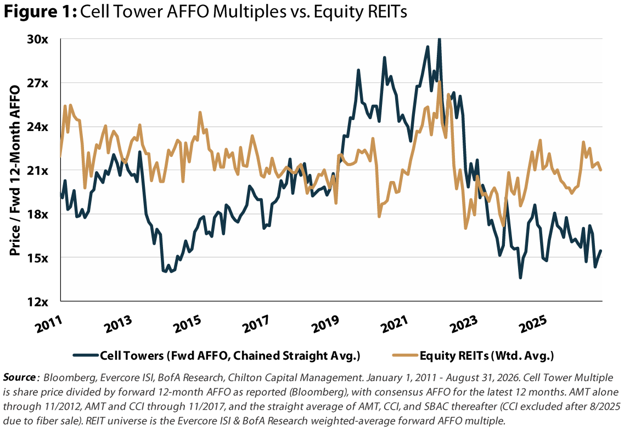
With cell tower REITs now valued without any revenues from Dish, the risk is completely out of the numbers, making for easy comps in 2027. In spite of this, cell tower REIT multiples are near 12-year lows as of August 31, 2026, as shown in Figure 1. Essentially, they are trading at trough multiples on trough earnings. We believe that part of the explanation for the depressed multiples is related to the perceived risk from satellite competition and the lackluster new leasing activity from the three main carriers. Based on our research, the first risk is minimal. In fact, though we have not incorporated it into our conservative earnings estimates, we believe it is more likely that Starlink drives more revenue to cell tower REITs. While new leasing will likely remain weak into 2027, this is baked into the current low multiples. As such, we have increased our weight to cell tower REITs in recent months based on an attractive risk-reward profile.
–
–
Refresher on Cell Towers
For any new readers or those who may need a quick update, the cell tower industry was born out of a need for shared infrastructure. Each carrier needs spectrum and cell sites to deploy a network. While the carriers own their own sites and spectrum, the costs are duplicative to having only one cell site per tower. A third-party cell tower landlord can have sites from multiple carriers on the same tower, resulting in the carriers paying less in rent than they would spend on a single-site tower network.
–
The cell tower landlord is only responsible for the steel tower structure, providing backup power to the site, and maintaining the land (e.g. mowing the grass, maintaining the fence), making the business extremely high-margin, especially when two or more rent-paying tenants occupy the tower. Leases are long term (5-10 years, with multiple tenant renewal options out to 30-40 years) with annual escalators (~3%), which makes the income stream predictable, yet sensitive to bond yields (values move in the opposite direction of interest rates). However, rents can grow beyond the escalators when there is ‘lease amendment’ activity, which could arise from upgrades (e.g. 4G to 5G), spectrum deployment, and net positive carrier activity (new locations, usually resulting from new coverage areas or densification, minus churn).
–
Good Times, Bad Times
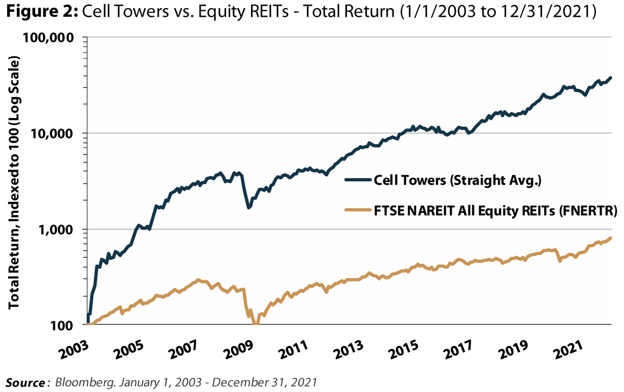
From 2003 to 2021, all of these factors worked in tandem, as there were four active carriers (Sprint, T-Mobile, AT&T, and Verizon), two significant upgrade cycles (2G to 3G and 3G to 4G), the beginning of the 5G upgrade cycle and declining bond yields. As shown in Figure 2, this generated spectacular annualized straight average total returns of 32.1% for the three publicly traded cell tower REITs from December 31, 2002, to December 31, 2021 (equivalent to a ~380x return!), which compared to 11.6% for the FTSE NAREIT All Equity REITs Index (Bloomberg: FNER) and 11.5% for the S&P 500. The business was recognized in the market as durable with high future growth, resulting in a price / AFFO multiple of 30x on December 31, 2021, which compared to the REIT average of 27x.
–
–
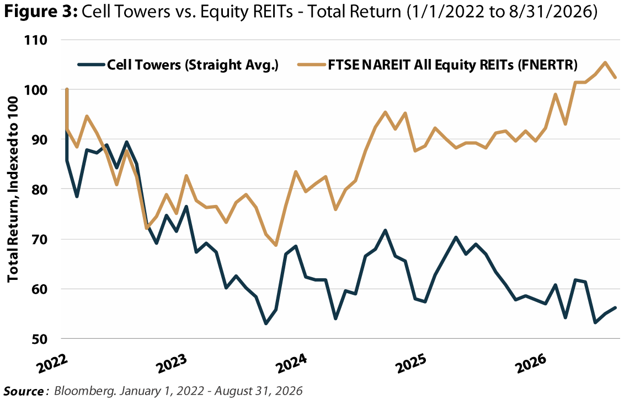
The period from 2022 to 2026 has been almost the exact opposite. First, the 5G upgrade cycle did not turn out to be as significant as the 4G upgrade cycle, as most cellular customers could not tell the difference between the two, and no ‘killer app’ emerged that necessitated the enhanced speeds that 5G could offer. Second, 2022 marked the fastest increase in interest rates in four decades, and the 10-year Treasury yield remains at these elevated levels today. Third, Sprint was bought by T-Mobile (NASDAQ: TMUS), consolidating two large carriers and allowing for the burn-off of leases on towers where Sprint and T-Mobile both had a site. As a result, the straight average annualized total return of the three cell tower REITs from December 31, 2021, to August 31, 2026, was -11.9%, which compares to +0.6% for the FNER, as shown in Figure 3.
–
–
Dirty Dish
When we wrote our September 2023 REIT Outlook, it was widely known that Dish was not a real fourth carrier. The company had held the spectrum for more than a decade and viewed it as its most valuable asset. However, Dish was in danger of losing its spectrum licenses unless it met the FCC’s buildout requirements. Dish began leasing space on towers, ultimately growing to ~2% of site leasing revenue at SBA Communications (NASDAQ: SBAC), ~4% at American Tower (NYSE: AMT), and ~5-6% at Crown Castle (NYSE: CCI).
–
In our September 2023 REIT Outlook, we acknowledged the risk around Dish, concluding that the depressed multiples did not give much credit for the Dish rent. Therefore, investors were getting a ‘free option’ on Dish emerging as a fourth carrier, potentially through a partner who could provide capital. In our July 2025 REIT Outlook, we stated, “In a worst-case scenario (bankruptcy), management [of AMT] expected the spectrum [of Dish] would be auctioned off and split among the Big 3, which would then be deployed to the benefit of AMT, and with a better credit tenant.”
–
In August and September 2025, Dish announced that it was selling spectrum to AT&T (NYSE: T) and SpaceX, essentially giving up on building its own network. Dish stopped paying rent to the three cell tower companies in January 2026 and declared bankruptcy in June 2026. While the outcome for recovery of owed rent from Dish is uncertain, the worst-case scenario did occur, largely as we thought. However, the sale to SpaceX brought an out-of-this-world risk back to the headlines: satellites.
–
Satellite Risk? Or Opportunity?
The story of SpaceX is nothing short of spectacular. The rocket-launching business made breakthroughs that NASA was unable to achieve on its own, and the proliferation of Starlink satellites has brought broadband to rural areas, airplanes, ships, and underserved countries that would otherwise be without access to the internet, or have much slower connections. In June 2026, SpaceX went public at a valuation of $1.8 trillion, the highest valuation for an IPO of all time!
–
As of June 30, 2026, SpaceX had approximately 3 million US paid subscribers on Starlink broadband, providing download speeds of up to 400 Mbps (according to SpaceX). This is fast enough for streaming and voice calls in homes, including from phones that are connected to a router over Wi-Fi.
–
In addition, T-Mobile began commercial service in partnership with Starlink in July 2025 using 5 MHz of leased spectrum, providing coverage directly to phones for an extra charge ($10 per month as of this publication). Due to handset and capacity constraints we will explain, the service is only strong enough to support texting, minimal data, and potentially voice using WhatsApp or X according to some reports. In January 2026, T-Mobile announced that it had 150,000 daily users of the service. While SpaceX reported 7.4 million unique mobile devices in its S-1 filing, we believe the majority of these either have the service as part of a bundled package or are outside the US. Research suggests that satellite data to mobile devices accounted for 0.0002% of total US mobile data in May 2026.
–
Once the transactions with Dish close, targeted for November 2027, SpaceX will have 65 MHz of spectrum and is expected to keep buying spectrum. To put this into perspective, each of the big three carriers has at least 300 MHz of spectrum deployed to a minimum of 120 million connected devices. Despite the large gap, the Starlink spectrum purchase should be what cell tower investors have been hoping for: a potential true fourth carrier with a strong balance sheet to drive new leasing, as well as increased competition among the other three carriers.
–
However, on SpaceX’s first earnings call as a public company after the close on August 4, CEO Elon Musk stated, “Instead of having to deploy these very expensive and difficult to locate large cellular base stations, we feel reasonably confident that we can deploy a large number of sort of small stations.” COO Gwynne Shotwell added, “So you can have kind of these little femtocells around the country and you deploy that as you need it…And I think it will be quite CapEx efficient.” In other words, Mr. Musk claims that he will be able to bypass cell towers completely in a rollout of a Starlink terrestrial network, AND do it for less money than if it used existing cell towers. This news sent the tower REITs down by an average of ~5% on August 5. The decision to invest in cell towers today necessitates understanding the implications of Mr. Musk’s comments and the varying effects they could have on the industry.
–
Musk vs. Physics
Importantly, Mr. Musk’s comments confirm the laws of physics as we understand them: a mobile carrier needs spectrum and terrestrial sites to deploy a network. So far, no carrier has been able to avoid cell towers in deploying a network. However, the use of femtocells (a category of ‘small cells’) has been around for more than a decade, mostly used in dense urban areas to offload data from cell towers (or ‘macro towers’).
–
Specifically, femtocells cover an area of 1,000-25,000 square feet and can support up to eight concurrent users. In comparison, a macro cell tower covers an area of 3-20 square miles and can support 500-2,500 users concurrently. Based on these numbers, we find it very difficult to believe that a network of femtocells would be cheaper to deploy than using macro towers. According to T-Mobile’s Chief Technology Officer, it would require 4 million femtocells to serve the city of New York alone. Furthermore, the number reaches 500 million to 1.5 billion sites to service the US. At $1,000 per femtocell, the cost would be staggering: $500 billion to $1.5 trillion! This does not even factor in the time, permitting, and backhaul that would be needed to install the sites. For reference, Crown Castle built small cell networks for a decade and experienced permitting times of 18 months or more. Therefore, we do not believe it is possible to build a network that relies on femtocells alone. Notably, CCI sold its small cell business at a steep loss in May 2026.
–
Yet, despite SpaceX’s own admission that it needs terrestrial sites, the depressed cell tower multiples suggest that some investors believe satellite direct-to-device will be a formidable alternative to macro towers. There are four main issues that support our belief that satellite direct-to-device will never be competitive with terrestrial cell towers: 1) from 200 miles in the sky, the beams are too wide to provide enough capacity per user in a dense area, 2) significant signal degradation to indoor handsets and moving targets (cars), 3) handset technology and power are not capable of receiving (or uploading) data from so far away, and 4) the cost is nowhere near efficient.
–
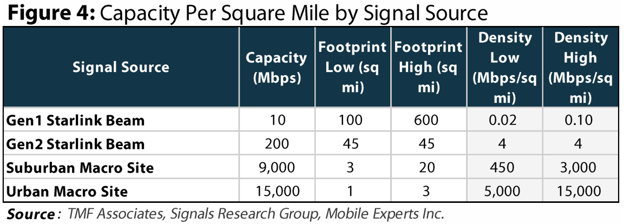
Starlink is estimated to have 650 first generation direct-to-device satellites circling the globe today, with plans to launch 1,200 next generation satellites in 2027 and 2028. These are estimated to have 20x the capacity per beam of the first generation. However, capacity is not the issue when it is so far away. First generation satellite coverage per beam is 100-600 square miles, and second generation satellites are aiming for 45 square miles. In comparison to a macro tower coverage area of 3-20 square miles, each beam would have to have 2-15 times the capacity of a macro site just to match it. As shown in Figure 4, even with the 20x improvement on a smaller footprint, the Mbps per square mile is still roughly 100x lower than that of the weakest suburban macro site. It is difficult to imagine and quantify the number of satellites and the technological advances in satellite capacity that would be required to cover an urban area anywhere near as well as a macro tower.
–
–
Signal degradation is an immutable law of physics that has a profound effect on building a network. The power of a signal declines in proportion to the square of the distance traveled (i.e. exponentially). So, a satellite that is 100x farther from the user (200 miles versus 2 miles) delivers a signal that is 10,000x weaker by the time it reaches its destination. This has significant effects on the ability of the signal to penetrate walls, trees, or metal surfaces (cars). Experts estimate that signal strength could be weakened by up to 90% by a wall or windshield. According to T-Mobile, only 10% of mobile data use occurs outdoors, with 80% occurring indoors and 10% in cars. This alone would make a direct-to-device network irrelevant for the vast majority of mobile traffic. Furthermore, satellites have difficulty ‘handing off’ for moving vehicles.
–
The only way to make up for the weaker signal is more power on the device antenna. Current handset technology cannot generate enough power to boost the signal to support any speed near that of macro towers, and regulations do not permit batteries with enough power to do it. Even if these constraints were solved, handset manufacturers would not likely be motivated to shoulder the increased costs for more powerful batteries.
–
Finally, the cost of constructing and launching satellites, each with an estimated useful life of five years, makes it completely uncompetitive with macro towers for direct-to-device traffic. Starlink has plans to deploy 14,000 more satellites in the future, but the nature of a satellite in orbit makes each one extremely inefficient. In its estimated 95-minute orbit time, each satellite spends 88% of its time over oceans and unpopulated land. As a result, Mobile Experts Inc. estimates that Starlink’s cost per gigabyte would be roughly double that of rural towers and 15-30x more expensive for urban towers over an eight-year period.
–
Back-to-Earth Scenarios
Until there are major advances in equipment, we believe macro cell towers have to be part of Starlink’s path to becoming a serious mobile carrier in the US. The current arrangement with T-Mobile could be a model for the future, where there is a hybrid of small cells and macro towers complementing satellite coverage in extremely rural areas without a macro tower. Or, Starlink could rent capacity from other carriers’ networks on macro towers as a mobile virtual network operator (MVNO), as Boost Mobile now does on AT&T’s network. Neither scenario is a threat to current cell tower revenue streams, and both would actually produce upside to cell tower REIT revenue. In the less likely event that Starlink rolls out a full terrestrial cell tower network, the implications would be extremely favorable for cell tower REITs.
–
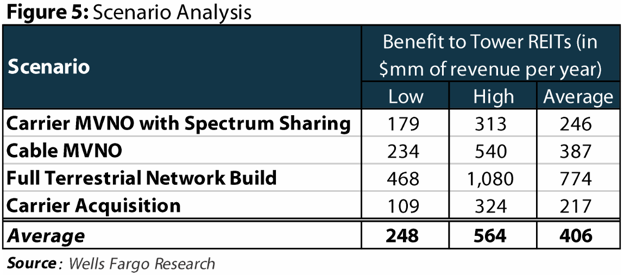
Wells Fargo Research attempted to quantify the potential revenue increase for the tower REITs across four scenarios, shown in Figure 5. The combined annual revenue increase for all three cell tower REITs ranged from $109 million to $1.08 billion across these scenarios, with the average of all scenarios at $248-564 million. In conclusion, we don’t see any scenario where Starlink entering the mobile market is a negative for cell tower REITs, and more than likely it will be a positive.
–
–
Chilton Positioning
As discussed in our June 2026 REIT Outlook, we decreased our cell tower allocation to a decade low of 5% earlier this year, which included selling our SBAC position in February. However, the further sell-off since then has created a buying opportunity, with risks skewed to the upside. We re-initiated a position in SBAC in July 2026 and have added further to the position on pullbacks, bringing our total cell tower exposure to 10.7% versus the VNQ weight of 8.6% as of August 31, 2026.
–
As of August 31, 2026, the straight-average AFFO multiple of the tower REITs was 15.5x, which compares to the trailing five-year average of 19.1x and the trailing 10-year average of 20.8x. This also compares to the current REIT average of 21.0x. We project that the tower REITs will grow AFFO per share by an average of 6-7% in 2027 and 2028, and we assume zero positive impact from Starlink new leasing. Furthermore, we are not assuming any recovery of lost rent from Dish, for which $2.4 billion has already been set aside in bankruptcy court – a potential floor for the total potential recovery. There are also several catalysts that could unlock further upside.
–
First, the FCC completed its first spectrum auction in June 2026 since 2022. There is a planned auction in 2027 and potentially another one in 2028. Second, we expect 6G upgrades to begin in 2029 or 2030, which should drive amendment activity. Third, AMT has a company-specific catalyst in that its CoreSite data center business could be monetized at some point. With data center REITs trading at multiples 7-8 turns higher than cell towers, the value of CoreSite is not being recognized within AMT. Lastly, SBAC was rumored to be exploring a sale of the company close to a price of $250 per share earlier this year. While no deal was consummated, the share price of ~$190 as of August 31 screens as very attractive if any deal were to materialize at even close to that number.
–
Risks to our thesis remain, however. We are basing our research on current equipment capabilities, for which there could be significant advances in the future. Additionally, competition from Starlink, albeit unlikely in our view, could weaken the credit quality of the three big US carriers. Finally, the cell tower REITs are among the most sensitive to interest rates, which would make it difficult to see outperformance without at least a stabilization in long term Treasury yields.
–
We believe that the current valuation of cell tower REITs accounts for these risks. Furthermore, the low multiples ignore the possible upside from the entry of a true fourth carrier. In 2027 and 2028, the cell tower REITs should be growing AFFO per share in line with the REIT average, which alone would warrant a higher multiple. As such, we believe that cell tower REITs present one of the best risk-adjusted reward profiles available in REITs today. It’s time for Mr. Buffett to take another look.
–
Matthew R. Werner, CFA
mwerner@chiltoncapital.com
(713) 243-3234
Bruce G. Garrison, CFA
bgarrison@chiltoncapital.com
(713) 243-3233
Isaac A. Shrand, CFA
ishrand@chiltoncapital.com
(713) 243-3219
Thomas P. Murphy, CFA
tmurphy@chiltoncapital.com
(713) 243-3211
–
VNQ: $96.44 (8.31.2026) vs. $88.49 (12.31.2025) vs. $116.01 (12.31.2021) vs. $56.91 (3.23.2020)
–
An investment cannot be made directly in an index. The funds consist of securities which vary significantly from those in the benchmark indexes listed above and performance calculation methods may not be entirely comparable. Accordingly, comparing results shown to those of such indexes may be of limited use.
The information contained herein should be considered to be current only as of the date indicated, and we do not undertake any obligation to update the information contained herein in light of later circumstances or events. This publication may contain forward-looking statements and projections that are based on the current beliefs and assumptions of Chilton Capital Management and on information currently available that we believe to be reasonable, however, such statements necessarily involve risks, uncertainties and assumptions, and prospective investors may not put undue reliance on any of these statements. This communication is provided for informational purposes only and does not constitute an offer or a solicitation to buy, hold, or sell an interest in any Chilton investment or any other security. Past performance does not guarantee future results.
Information contained herein is derived from and based upon data licensed from one or more unaffiliated third parties, such as Bloomberg L.P. The data contained herein is not guaranteed as to its accuracy or completeness and no warranties are made with respect to results obtained from its use. While every effort is made to provide reports free from errors, they are derived from data received from one or more third parties and, as a result, complete accuracy cannot be guaranteed.
Index and ETF performances [RMZ, VNQ, and FNER] are presented as a benchmark for reference only and does not imply any portfolio will achieve similar returns, volatility or any characteristics similar to any actual portfolio. The composition of a benchmark index may not reflect the manner in which any is constructed in relation to expected or achieved returns, investment holdings, sectors, correlations, concentrations or tracking error targets, all of which are subject to change over time.


